by Ann Garrison, Didas Gasana and Charles Kabonero
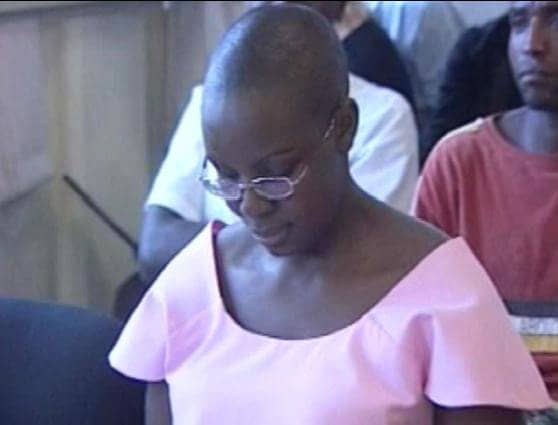
Victoire Ingabire Umuhoza, her head shaved and wearing her pink prison uniform, makes an appearance in court. In jail since Oct. 14 and reportedly tortured, she was recently denied bail. She had returned to Rwanda last January to challenge Paul Kagame for the presidency but was not allowed to run. Many commentators predicted she would have won a free and fair election.
The argument over who has been most to blame for the bloodshed in recent East Central African history intensified even further this month with testimony further challenging the history of what we know as the 1994 Rwanda Genocide at the International Criminal Tribunal on Rwanda.
Rwandan President Paul Kagame’s former bodyguard, Aloys Ruyenzi, testified at the International Criminal Tribunal on Rwanda that the president of the Interahamwe, the militia said to have massacred the Rwandan Tutsi population in 1994, was himself a Tutsi and Rwandan Patriotic Front agent.
Ruyenzi, in an interview in the Newsline East Africa, also described what he called “killing spots” where, he says, the Kagame regime continues to sort, classify and then systematically execute those it perceives as enemies with bayonets or, if they resist or run, with pistols.
Law Professor Peter Erlinder, with his Kenyan lawyer Kennedy Ogetto, who is also one of his fellow criminal defense attorneys at the Interational Criminal Tribunal on Rwanda. Erlinder wears the pink prison garb of Rwandan prisoners that Victoire Ingabire Umuhoza, whom he had traveled to Rwanda to defend, wears now.
Audio link: http://goo.gl/hToVb.
Transcript:
KPFA Weekend News Host Cameron Jones: Minnesota William and Mitchell Law Professor and International Criminal Tribunal on Rwanda Defense lawyer Peter Erlinder has issued a press release stating that, according to high-level Rwandan officials present at a meeting in Rwanda's capitol Kigali in mid-October, Rwandan President Paul Kagame ordered that he, Erlinder, be brought back to Rwanda “dead or alive.” KPFA's Ann Garrison has the story.
KPFA/Ann Garrison:
Law Professor Peter Erlinder says that former members of the Rwandan government, now in exile, report that Rwandan President Kagame said “Erlinder’s release was a mistake” and that he and Paul Rusesabagina, the author of "An Ordinary Man," the book that the film Hotel Rwanda was based on, were responsible for drawing worldwide attention to the detailed 600-page UN report released Oct. 1, that exposes the role of Kagame’s Rwandan Patriotic Front and its army in war crimes, crimes against humanity, and massacres of Hutu civilians.
Erlinder says that he has notified federal and local law enforcement officials and the U.S. State Department of the danger, and requested protection both for himself and for his confidential source. Speaking to KPFA today, from his home in St. Paul-Minneapolis, he explained why he will not be returning to Rwanda:
Law Professor Peter Erlinder:
On Oct. 6, the UN Tribunal for Rwanda issued a decision in which it said that the prosecution against me was illegal under UN immunity rules. As a result I have no obligation to answer to an illegal prosecution in Rwanda. And since that time, UN reports of the mass murders by the Kagame regime in Rwanda and in the Congo make it clear that returning to Rwanda would be suicide for anyone that Kagame considers a threat to his absolute power, and my returning to Rwanda is out of the question at this point."
KPFA/Ann Garrison:
What do you think about Kagame's growing enemy list?
Peter Erlinder: Well, within the last several months, of course, nearly all of Kagame's opponents and journalists in the independent press have either been arrested or killed. The government newspaper has reported that Paul Rusesabagina of Hotel Rwanda's foundation is part of an Obama Administration/UN conspiracy to discredit the Kagame regime. And Rwanda's Ambassador to the U.S. has actually accused the former U.S. Ambassador to Rwanda, Robert Flatten, of being a gun runner. And as the enemies' list grows, this desperation only makes the regime more dangerous anywhere in the world, and I must take seriously the death threats that have been reported to me.
UN documents that are in evidence at the UN Tribunal, which of course are the reason for the charges against me in Rwanda, show that Kagame is responsible for the Rwanda Genocide already. And RPF culpability for the six million deaths in the Congo, reported in the UN Report that was made public October 1st, is in the public record too.
And a regime capable of these crimes is capable of eliminating its opponents anywhere it can reach them.
KPFA/Ann Garrison:
Has anyone from the State Department responded to the information that you gave them?
Peter Erlinder:
I haven't heard back from the State Department in any official way.
For more coverage of Peter Erlinder's case and related news reported from East/Central Africa, Europe, and the U.S., see the website of the San Francisco Bay View Newspaper, www.sfbayview.com.
San Francisco LGBT rights activists met this week, with Ugandan Bishop Christopher Senyonjo, one of the most outspoken opponents of Uganda's Anti-Homosexuality Act, also known as the Hang-the-Gays bill. The local gay activists discussed how to support Senyonjo and his work there, as well as how to arrange immigration and legal asylum for LGBT Ugandans who feel they're unsafe if they stay in their country. KPFA's Ann Garrison spoke with Kushaba Moses Mworeko, a gay Ugandan who's applied for asylum in the U.S., and she filed this report.
KPFA/Ann Garrison:
Kushaba Moses Mworeko left Uganda seeking asylum and to attend an HIV/AIDS conference in Texas in October 2009. Washington D.C.'s lesbian and gay Metro Weekly Magazine then interviewed him here and put his picture on their cover with the headline, "The Promised Land," referring to his pursuit of legal asylum in the U.S. Uganda's Red Pepper tabloid reprinted part of the interview with the headline "Gay Monster Raped Boys in School but Failed to Bonk Wife." Moses says that his life, as a result, would be in even greater danger now, if he were to return to Uganda.
Moses Mworeko:
Yeah, yes, my life would be in danger because of the extensive media coverage that I have had here and in Uganda, and the provocative coverage from the Red Pepper and other homophobic, witch hunting tabloids in Uganda that keep asking the government of Uganda to hang us.
KPFA/Ann Garrison:
And are all Ugandans who are out of the closet in as much danger as you are?
Moses Mworeko:
Yes, of course they are, especially those who have been outed in the hate newspapers like the Red Pepper, Uganda's Rolling Stone, and the Onion, which published pictures and addresses of those they called Uganda's Top Homos, including even Bishop Senyonjo, even though he is a heterosexual advocate for LGBT rights.
KPFA/Ann Garrison:
Why do you think Ugandan MP David Bahati and other supporters of the Anti-Homosexuality Act, which seemed to have been set aside, are pushing it towards a vote in Parliament again now?
Moses Mworeko:
I think the major reason is that the elections are coming up at the beginning of next year, so people want to force the presidential candidates to take a stand one way or the other. For instance, these past weeks, during the AIDS celebrations, the sheikhs kept on asking the presidential candidates to take a stand and show whether they are with them or not. So I think that's why it's coming up very soon.
KPFA/Ann Garrison:
What would you most like the international community to understand about homophobia in Uganda and what would you like them to do?
Moses Mworeko:
I would like the international community to understand that LGBT Ugandans are in danger, and especially when the tabloids publish their pictures and addresses. Of course those who are working lose their jobs and cannot be able to find work. They may even be targets for mob justice, since outing them essentially means social suicide, because you won't have friends, you won't go to church, you won't have any relatives, so that is a big problem. The schoolgoing children are expelled from school and cannot go back to school, and that means they will end up on the streets, they will be homeless, and start abusing drugs, and end up having HIV and AIDS. So people are now in fear and despair. And I hope the international community will continue supporting Ugandans' local human right organizations like Sexual Minorities Uganda, Gay Uganda, and Integrity Uganda that defend LGBT rights.
KPFA/Ann Garrison:
Moses, thank you for coming into the KPFA Studios today.
Thirty two years ago, San Francisco Supervisor Dianne Feinstein delivered news that stunned the Bay Area and the nation.
(Then President of the Board of Supervisors) Dianne Feinstein:
As President of the Board of Supervisors, it's my duty to make this announcement. Both Mayor Moscone and Supervisor Harvey Milk have been shot and killed.
The . . . (more shudders and cries) . . . the suspect is Supervisor Dan White.
KPFA/Anthony Fest:
Tomorrow will be the 32nd anniversary of the deaths of Harvey Milk and George Moscone. The two men gunned down on November 27th, 1978, had followed very different paths to City Hall. Moscone was a native San Franciscan who'd been a City Supervisor and State Senator before winning the 1975 mayor's race. Harvey Milk had moved to San Francisco from New Jersey in search of a more gay friendly place to live. He opened a camera store on Castro Street, but soon began spending much of his time on political organizing, including a successful campaign to have members of the Board of Supervisors elected by district, rather than citywide. Milk then won a Supervisor's seat himself in 1977, becoming one of the first openly gay elected officials anywhere in the U.S. He also touted coalition building as a key to success in local politics.
Harvey Milk:
There's tremendous harmony developing. It's not perfect, by any means. At a citywide level, I think it's vital that the minorities, the traditional ethnic minorities, and the gays, and the feminists link together. Possibly the rank and file union, not the union leaders, the rank and file, link together to form a very solid, strong coalition, so that we can influence the total direction of the city.
KPFA/Anthony Fest:
As a City Supervisor, Milk worked on a variety of issues, from rent control to voting security, but he was best known as a passionate advocate of equal rights for gays and lesbians. He played a leading role in the defeat of Proposition 6, a state ballot measure that would have forbidden openly gay people from teaching in California schools.
Here is Milk at a debate on Prop 6:
Harvey Milk:
I was born of heterosexual parents. I was taught by heterosexual teachers, in a fiercely heterosexual society, with television ads and newspaper ads. Fiercely heterosexual, a society that puts down homosexuality.
Then why am I a homosexual, If I'm affected by role models? I should have been a heterosexual. And no offense meant, but if teachers are gonna affect you as role models, there'd be a lotta nuns running around the streets today.
KPFA/Anthony Fest:
Meanwhile conservative Supervisor Dan White, Milk's political opposite on the Board, was becoming disgruntled with elective office. White abruptly announced his resignation, but soon afterward changed his mind, and asked Mayor Moscone for a reappointment to the now vacant seat. When White learned that Moscone intended to appoint someone else, he made his way to City Hall with a pistol. He entered the building through a window to avoid the metal detectors at the doorways, then entered Moscone's office. Following an argument, he killed Moscone, then walked down the hall and killed Milk.
Though Milk’s life and political career were cut short, members of the LGBT community say he was a pioneer whose influence endures decades later. Tommi Avicolli Mecca, a longtime writer on gay issues, assesses Milk’s legacy:
Tommi Aviola Mecca:
I think what he represents is a progressive queer voice, and I think that's an important distinction to make because I think we progressive queers don't get credited any more with the work we did in the 70s. He was a maverick in every sense of the word because, y'know, he went against the Democratic establishment. Y'know, and Harvey's whole thing was well, no, but queers should represent queer people, and that, at that time, was a radical idea.
KPFA Anthony Fest:
On the day Milk was killed, members of the San Francisco gay community gathered for a candlelight march from Castro Street to City Hall. Those memorials have continued ever since, on the anniversary of Milk’s death. Tomorrow’s event will begin at 6:00 pm at the corner of Castro and Market Streets.
Candlelight march on San Francisco’s Market Street following November 27 1978 assassination of Supervisor Harvey Milk.
KPFA Weekend News Host Anthony Fest:
And turning now to news from Africa, the dispute over who is responsible for the bloodshed in East/Central Africa over the past 16 years intensified this month when, on November 9th, Rwandan President Paul Kagame's former bodyguard testified at the International Criminal Tribunal on Rwanda. Following that testimony he told a newspaper and website that Kagame summarily executes political enemies. On November 12 Rwanda's High Court sent an opposition leader back to prison. Now a new Dutch Parliament seems close to confirming that it will no longer support Kagame's government. KPFA's Ann Garrison has the story.
KPFA/Ann Garrison:
Rwandan President Paul Kagame's former bodyguard Aloys Ruyenzi testified, at the International Criminal Tribunal on Rwanda, that the President of the Interahamwe, the militia said to have massacred the Rwandan Tutsi population in 1994, was himself a Tutsi and Rwandan Patriotic Front and Army agent. Ruyenzi, in an interview with The Newsline East Africa, also described what he called "killing spots," where, he says, the Kagame regime continues to sort, classify, and then systematically execute those it perceives as enemies.
The Kagame regime's High Court in turn denied opposition leader Victoire Ingabire Umuhoza's bail appeal, and sent her back to prison to await trial for conspiring with terrorists and genocide ideology, which means disagreeing with the official history of the 1994 Rwanda Genocide.
Rwandan exiles and supporters have demonstrated in Brussels, the Hague, and London since Ingabire's arrest, and the new Dutch Parliament seems to be moving toward a vote to sustain a 2008 decision to cut economic aid to Kagame's Rwandan regime because of its human rights abuses in the neighboring Democratic Republic of Congo and because of Ingabire's imprisonment.
Vincent Harris is a Dutch new media consultant and writer. Harris says that the Dutch Parliament's decision could raise the question of why other European nations and the U.S. continue to provide economic and military aid to Rwanda:
Colored Opinions Blogger/Writer/New Media Consultant Vincent Harris:
In December the final decision concerning budget support, whether the Netherlands will resume budget support to Rwanda, will be made by the Minister of Foreign Affairs. Kigali's reputation is at stake. Once the Dutch government freezes budget support again, it's a strong signal to all European partners, and also to, for instance, the US and the UK to explain why they think they should keep supporting this regime.
KPFA/Ann:
Harris says that Ingabire was a respectable, working, lawabiding, resident of the Netherlands, where her family still resides, for 16 years, before her return to Rwanda, and that church groups with significant influence are collecting petition signatures, to be addressed to the Dutch Parliament, asking the legislative body to lobby for her safety and human rights.
Harris reports that the Dutch Parliament has already asked its embassy staff to attend her trial as witnesses, though they do not believe that she can receive a fair trial in Rwanda.
KPFA WEEKEND NEWS HOST GLENN REEDER:
The UN General Assembly voted this week, to remove lesbian, gay, bisexual, and transgender people from a list of vulnerable populations in need of equal protection from extrajudicial, summary, or arbitrary execution. This UN list of vulnerable populations has included sexual minorities for the past 10 years, though some nations have argued to remove them without winning a majority till this week. KPFA's Ann Garrison has the story.
KPFA/ANN GARRISON:
For the last 20 years, the International Gay and Lesbian Human Rights Commission has responded to the violence that lesbian, gay, bisexual and transgender people face all over the world.
IGLHRC AUDIO, FROM THEIR VIDEO ON VIOLENCE AGAINST LGBT: I think the greatest injustice that LGBT people face is violence. Violence is consistently used as a tool of intimidation. In 80 countries around the world, same sex acts are criminalized in one way or another. Tragically, today, it's far too common that LGBT people around the world are routinely and brutally attacked, tortured, and even murdered. There's a death penalty issue in many countries, for just being gay or lesbian. When someone is killed, in Uganda, because they've been imprisoned because of their sexual orientation, we have to respond to that, and we know how to respond to that. We've been doing it for the last 20 years.
KPFA/ANN GARRISON:
The list of populations that the UN General Assembly resolution identifies as particularly vulnerable to extrajudicial, summary, or arbitrary execution still includes national, ethnic, religious, or linguistic minorities, persons affected by terrorism, hostage taking or foreign occupation, refugees, internally displaced persons, migrants, street children, indigenous communities, human rights defenders, lawyers, journalists, demonstrators, targets of honor killings, and all killings committed for any discriminatory reason," BUT, the phrase "including sexual orientation" is no longer added to "any discriminatory reason," because of an amendment passed by nine votes. Most Middle Eastern and African nations, and China and the Russian Federation, voted yeah.
The UN General Assembly votes every two years on a resolution condemning extrajudicial, summary, and arbitrary executions worldwide, which includes the list of those particularly vulnerable and in need of protection.
International Gay and Lesbian Human Rights Commission Researcher Sara Perle says that though a majority vote settles the text of the resolution, and the list, the process is most of all about building consensus:
IGLHRC/SARA PERLE:
This amendment attempts to create an obstacle to building evidence that there is consensus in international human rights law, that, discrimination on the basis of sexual orientation is never permissible.
KPFA/ANN GARRISON:
Mauritius, an island nation off the East African Coast, was the only African nation that abstained from voting, though 8 African nations were not present to vote.
The Democratic Republic of Congo and neighboring East African nations of Rwanda, Uganda, and Burundi, all voted to remove "including sexual orientation," and all have proposed and/or existing laws criminalizing homosexuality.
Legislation pending in Uganda and Congo also includes provisions for expelling human rights defenders and NGOs by criminalizing defense of LGBT rights. The International Lesbian and Gay Human Rights Commission's Sarah Perle says that it is therefore a threat to human rights throughout the region:
IGLHRC/SARA PERLE:
Countries like Uganda are seeking to further criminalize homosexuality and it's true that the Anti-Homosexuality Bill Even more disturbing, attacks on
KPFA/ANN GARRISON:
The UN Mapping Report on Human Rights Abuse in the Democratic Republic of Congo, leaked on August 26th and released on October 1st, documented the Rwandan, Ugandan, Burundian, and Congolese armies' guilt in war crimes, crimes against humanity, and massacres of Rwandan and Congolese Hutu civilians that an international criminal court would be expected to prosecute as genocide crime.
The UN Rapporteur on Extrajudicial, Summary, and Arbitrary Executions, Philip Alston, has criticized the U.S. for its extrajudicial, summary, and arbitrary killings in Iraq, Afghanistan and Pakistan, including killings with Predator Drones escalated under the Obama Administration, and for the discriminatory use of the death penalty in states like Texas and Alabama.
The UN Rapporteur has also spoken to the complicity of the UN, meaning the Security Council, which includes the U.S., in unlawful killings in Congo. See Democracy Now, 10.28.2009.
The deletion of LGBT people from the list of vulnerable populations has gotten a great deal of international press; the U.S. abstention on the final resolution virtually none. This is the U.S. Mission to the United Nations's official explanation:
Explanation of Vote by a U.S. Advisor of Extrajudicial, Summary or Arbitrary Executions Resolution (A/C.3/65/L.29), Third Committee
U.S. Advisor
New York, NY
November 16, 2010
AS DELIVERED
Thank you, Mr. Chairman,
Although we abstained on the adoption of this resolution today, we wish to join the sponsors of the text in condemning extrajudicial, summary or arbitrary executions against all persons, irrespective of their status. We of course agree that all States have obligations to protect human rights and fundamental freedoms and should take effective action to combat all extrajudicial killings and punish the perpetrators. We agree that countries such as ours, which have capital punishment, should abide by their international obligations, including those related to due process, fair trial, and use such punishment for only the most serious of crimes. Indeed, we agree with much of the text of this resolution. However, we have some concerns.
At the outset, let me say that the United States strongly agrees with and appreciates the cosponsors' efforts to retain language specifically condemning ESAs targeting vulnerable groups, particularly members of the LGBT community, and we were dismayed that this reference could not survive an unfriendly amendment.
We also have concerns about the language of the resolution in a few other areas and, therefore, were unable to vote for the resolution as a whole. Much as we agree with the goals and sponsors of the resolution, we are not in a position to vote for a text that obscures a fundamental point: there are not one, but two bodies of law that regulate unlawful killings of individuals by governments - international human rights law and international humanitarian law. As noted by the resolution, these two bodies of law are complementary and mutually reinforce one other. We also recognize that determining what international law rules apply to any particular government action during an armed conflict is highly fact-specific and made even more difficult by the changing nature of warfare. However, the applicable rules for the protection of individuals and conduct of hostilities in armed conflict outside a nation’s territory are typically found in international humanitarian law. Rather than clarifying, the resolution as worded only contributes to legal uncertainty about how these two important bodies of law apply to an array of factual circumstances.
LAKE FOREST – Former President George W. Bush will sit down for a conversation on leadership with Pastor Rick Warren during Saddleback Church's 6th Civil Forum later this month.
The forum, planned for Nov. 29, will focus on Bush's leadership and is expected to include discussion of excerpts from the former president's book, "Decision Points," Warren's chief of staff David Chrzan said.
President George W. Bush talks with pastor Rick Warren, founder of the Saddleback Valley Church, Lake Forest, Calif. after receiving an award from Warren as they participate in the Saddleback Civil Forum on Global Health, Monday, Dec. 1, 2008, at the Newseum in Washington.
The book, released Tuesday, chronicles what Bush considers to be pivotal moments in his eight-year presidency and is aimed at defining his role as a world leader. Bush details a range of decisions from quitting drinking to deploying American troops after Sept. 11.
"The forum will include a personal conversation between Pastor Rick and President Bush," Chrzan said. "The goal is to create a forum where the community around Saddleback Church can hear from speakers who are great leaders and those who have positively impacted humanity."
Bush has been on national TV book tour, appearing in prime time Monday night in an interview with "Today Show's" Matt Lauer, and sitting with Oprah Tuesday afternoon.
The former president pointed to the 9/11 attacks as the moment when his administration was given an objective. As he wrote: "In a single morning, the purpose of my presidency had grown clear: to defend our freedom that had come under attack."
He also writes about the use of torture on members of Al Qaeda, and the bad intelligence regarding weapons of mass destruction in Iraq.
Saddleback Church's previous forums have focused on orphans and adoption, Holocaust survivors, global health, persecution of Christians, the presidency, and the power of reconciliation, a discussion that featured the president of Rwanda.
The 6th Saddleback Civil Forum will be held at Saddleback Church, 1 Saddleback Parkway. The event is open to the public. The time is still to be determined, Chrzan said.
If you value my independent reporting please help support it by clicking the "Donate" button and contributing. Any amount, large or small will be important to me.






 Posts
Posts