Phone call to Victoire Ingabire Umuhoza's daughter Raissa Ujeneza, in the Netherlands, after Netherlands police raided her parents' family home in Zevenhuizen, the Netherlands, on Monday, 12.13.2010.
Ingabire police raid sparks angry reactions
Published on : 14 December 2010 - 3:27pm | By Sophie van Leeuwen (Photo: RNW)
Report posted to Radio Netherlands, 12.14.2010.
Wednesday, December 15, 2010
Monday, December 13, 2010
KPFA News: Victoire Ingabire's Daughter Raissa Ujeneza on Europe and the Kagame regime
KPFA Weekend News Anchor Anthony Fest:
On December 6th, the government of the Netherlands froze budget support for Rwandan President Paul Kagame's regime, citing human rights abuse and concern that imprisoned Rwandan opposition leader Victoire Ingabire Umuhoza cannot receive a fair trial in Rwanda, where she is charged with terrorism and genocide ideology. Kagame then met angry street protest, during the rest of last week, at a European development conference in Brussels, where several European leaders avoided meeting or being photographed with him. KPFA's Ann Garrison has the story.
KPFA/Ann Garrison:
Professor Ed Herman, co-author, with Noam Chomsky, of Manufacturing Consent and many other books, describes Rwandan President Paul Kagame as "the worst killer on the planet."
On April 30th this year, a legal team including American Law Professor and international criminal defense lawyer Peter Erlinder sued Kagame, in an Oklahoma City civil court, for the assassination of the Rwandan and Burundian Presidents that triggered the Rwanda Genocide, and racketeering to plunder the resources of Rwanda's neighbor, the Democratic Republic of the Congo, costing millions more lives.
In mid-July Spanish demonstrators took to the streets with hands and faces drenched in red paint to simulate blood, chanting "Kagame! War Criminal! Assassin!" and Spanish Prime Minister Jose Luis Zapatero refused to meet or be photographed with Kagame.
On December 6th, the Netherlands froze budget support to the Kagame regime, and during the rest of the week hundreds of exiled Rwandan and Congolese demonstrators banged drums in the streets of Brussels, chanting "Kagame! Murderer!” after he arrived there for a European development conference. They urged European donor nations to follow the Netherlands lead, but Britain's Foreign Minister David Cash argued for ongoing support and, by the end of the week, both Britain and Sweden had pledged major cash grants.
Raissa Ujenza, the daughter of imprisoned Rwandan opposition leader Victoire Ingabire Umuhoza, spoke to KPFA the Netherlands, where Ingabire lived in exile for 16 years before returning to Rwanda Ujenza and Ingabire's husband and two other children continue to live in exile. Ingabire for 16 years before returning to Rwanda
KPFA:
Are you encouraged by the Netherlands' decision?
Raissa Ujeneza:
Yes, I am. Very much so.
KPFA:
What about the church groups? There were a number of church groups collecting signatures to ask the Dutch government to call for respect for your mother's human rights? Did you have any contact with the church groups?
Raissa Ujeneza:
Not myself. My father, my grandmother, and my aunt are in contact with the church groups. They have spoken and set up collecting signatures.
KPFA:
Do you think it's been significant that you and your family, like most people in the Netherlands and in East/Central Africa, are Christian?
Raissa Ujeneza:
Yes, but also, every person who is religious feels a connection and is connected with others who are also religious, and that helps us in standing stronger together, helping my mother and supporting her in her action.
KPFA:
Do any other European nations now seem inclined to follow the Netherlands lead?
Raissa Ujeneza:
Spain, definitely is supporting actions for Rwanda to act better, but I think it will be a slow process.
KPFA:
Your mother spoke to KPFA a number of times, between her February arrest and her re-arrest and imprisonment on October 15th, and she always said, adamanty, that she rejected violence, and that the country's problems had to be resolved by democracy and debate. Can you imagine your mother being involved in a violent terrorist conspiracy?
Raissa Ujeneza:
I cannot imagine my mother being involved in a violent terrorist conspiracy at all. Her purpose is for Rwanda to be a country where all citizens feel free and have equal rights. And she fights for reconciliation and stability in Rwanda, and not by violence but by peaceful methods. I really do believe that the accusations are a way for the Rwandan government to put her down and to shut her off.
KPFA:
What would you most like the world to understand about what she represents, in Rwanda and the wider region, including Congo?
Raissa Ujeneza:
I would like the world to understand about my mother that she stands firm in what she believes. She's a smart, strong, and kindhearted person, who cares very much for her country and wants to make a difference. And every person who would observe her would see that she has all the qualities that are needed to bring the necessary changes. Too many people are still dying and still suffering.
KPFA:
Do you think that the Rwandan people and those of the wider region have had a lot of hopes that Barack Obama, the first African American president would make a significant difference in the region?
Raissa Ujeneza:
Yes I do believe a lot of people have a certain faith in him and I really hope he can live up to those hopes.
KPFA:
Raissa, thank you for speaking to KPFA.
Raissa Ujeneza:
You're welcome, and Merry Christmas.
KPFA:
For Pacifica/KPFA Radio, I'm Ann Garrison.
Labels:
Congo,
Kagame,
KPFA,
Netherlands,
Raissa Ujeneza,
Rwanda,
Victoire Ingbire Umuhoza
Saturday, December 11, 2010
US calls for UN resolution including LGBT rights, but won't vote for it
Susan Rice, 27th U.S. Ambassador to the United Nations.
On December 10th, Susan Rice, U.S. Ambassador to the UN, said she would attempt to add an amendment to the UN Resolution Condemning Extrajudicial, Summary, and Arbitrary Execution, which would restore LGBT people to the list of those in need of special protection. She delivered the remarks below on the 62nd annual Human Rights Day, which celebrates the UN ratification of the Universal Declaration of Human Rights, at a meeting of the UN LGBT Core Group, which the U.S. has joined.
Good move, of course, but the U.S. won't vote for the UN Resolution Condemning Extrajudicial, Summary, or Arbitrary Execution even if an amendment including queer folks is added to the list of those in need of protection. The U.S. has abstained every time the resolution has come to a vote, as it did, once again, on November 16th, because the UN Rapporteur on Extrajudicial, Summary, and Arbitrary Execution has called the U.S. out on racially discriminatory application of the death penalty in prisons in the Deep South, unlawful deaths in immigrant detention camps, and the use of Predator Drones, and further unlawful execution in Iraq and Afghanistan.
Remarks by Ambassador Susan E. Rice, U.S. Permanent
Representative to the United Nations, during an LGBT Core
Group Event Marking Human Rights Day, ECOSOC Chamber
Susan E. Rice
U.S. Permanent Representative to the United Nations
U.S. Mission to the United Nations
New York, NY
December 10, 2010
AS DELIVERED
Thank you all very very much. It’s really great to be with you here today.Friends and colleagues, we’re gathered because of a great victory for the cause of liberty. Sixty-two years ago today, on December 10, 1948, in the cold of a winter night in Paris, the ambassadors to the United Nations General Assembly voted to adopt the Universal Declaration of Human Rights. Paris was then still bruised and battered from the Nazi occupation. The world was still scarred and shaken from the bloodiest and most savage war in history. Yet, when the Declaration came before the delegates, it passed without a single dissenting vote.
Today, we do more than salute the wisdom of Eleanor Roosevelt and her fellow drafters, who added the Universal Declaration to the canon of great human rights charters. Together, we recommit ourselves to making liberty real for all human beings, regardless of race, creed, gender, or sexual orientation. We reaffirm today our common humanity. We celebrate the different ways in which we have been created. And we push ever forward towards new frontiers for human freedom, human dignity, and human rights.
I’m particularly honored that some of the brave activists on the front lines of that struggle are here with us today. The United Nation’s theme for Human Rights Day this year is “human rights defenders worldwide who act to end discrimination.” We’re joined by determined and defiant men and women who have suffered persecution, harassment, and outright violence simply because of their sexual orientation or gender identity. You have shown great courage and conviction in the face of bigotry and intolerance, and I’m deeply moved to be here with you.
The story of my country is, in part, a story of the expanding boundaries of rights and dignity—of the way that discrimination and prejudice have been countered by acceptance and equality. I feel this deeply and I feel it very personally. Even at a time of profound challenges at home and abroad, we dare not give up on the great causes of equality and fundamental rights. And that includes the pursuit of full and equal rights for the millions of people in this country and around the world who are gay, lesbian, bisexual, or transgender.
We’ve made real gains in the past decades, but the pace of progress remains too slow. As President Obama has said and I quote, “There are still laws to change, and there are still hearts to open. There are still fellow citizens, perhaps neighbors, even loved ones—good and decent people—who hold fast to outworn arguments and old attitudes; who fail to see your families like their families; who would deny you the rights most Americans take for granted.” But, as we can never forget, change comes from human agency. It comes from people—like the human rights defenders with us here today—people who refuse to give up and who refuse to move to the back of the bus. It comes from the leaders, the activists, and the ordinary men and women who believe that all human beings have equal worth, equal dignity, equal consequence—and equal rights.
This conviction underpins the significant steps that the United States has taken over the past two decades to advance the human rights of all of those who are gay, lesbian, bisexual, and transgender.
First of all, I am particularly proud to say that the United States is the newest member of the LGBT Core Group here at the United Nations. That decision was long overdue, and it gives me great personal satisfaction to sit before you representing the United States today.
I’m also particularly proud that one of the very first decisions our new Administration made at the United Nations was to join the General Assembly’s Statement on Sexual Orientation and Gender Identity, which condemns violence, harassment, and discrimination based on sexual orientation and gender identity.
This past July, the United States, working with other delegations, won NGO consultative status for the International Gay and Lesbian Human Rights Commission. That made it the first LGBT group from the United States to secure this status—and one of only a few LGBT groups worldwide. Some didn’t want to see LGBT rights recognized at the United Nations. But with others, we rolled up our sleeves and we got it done.
The State Department’s annual Human Rights Report now includes a section on how LGBT persons are treated in every country. And last summer, the State Department announced a new grant to provide emergency aid to some human rights defenders, either because they work on LGBT issues or because they are lesbian, gay, bisexual or transgender themselves.
Even as we work to support LGBT persons abroad, we are leading by example and pushing to ensure that their rights are fully realized here at home.
Last year, President Obama signed into law the Matthew Shepard and James Byrd Jr. Hate Crimes Prevention Act, which made it a federal crime to violently attack someone because of their sexual orientation or gender identity. Law enforcement officials in this country now have the tools to respond to gay-bashing and related violent acts wherever they occur in the United States. And for the first time, the words “sexual orientation” and “gender identity” became part of U.S. law to provide explicit protection to LGBT individuals.
Last summer, President Obama issued a presidential memorandum extending, to the extent permissible under current law, federal benefits to the same-sex domestic partners of U.S. government employees. Secretary of State Clinton extended benefits for overseas State Department employees, and this act, I’m proud to say, has served as a model for similar changes for LGBT Americans working for the UN Secretariat.
The Administration renewed the Ryan White CARE Act, which provides lifesaving medical services and support to Americans living with HIV/AIDS. We’ve eliminated the discriminatory ban that kept people out of the United States based on their HIV status. The Department of Housing and Urban Development is opening core housing programs to all Americans, regardless of sexual orientation and gender identity. And President Obama has appointed more LGBT officials to his government than the previous two Administrations combined.
But we have got a great deal more work to do.
Around the world, laws that criminalize gay relationships don’t just violate human rights. They hinder social cohesion, economic development, and public health. They reduce trust and cooperation among nations. So the United States will work together with our fellow Core Group members to urge countries that still have such laws to repeal them. And I hope we will all work together to develop a sustained, serious plan of action to decriminalize homosexuality around this world that we share.
Here at the United Nations, like many of you, I was incensed by the recent vote in the General Assembly’s Third Committee, which eliminated any mention of lesbian, gay, bisexual, and transgender individuals from a resolution condemning extrajudicial killing of vulnerable people around the world. We fought hard for that reference when it came to a Committee vote, and we lost. But we’re not done yet. The resolution now goes to the full General Assembly. For countries that voted in the Committee to keep the reference to sexual orientation, we thank you. For countries that haven’t yet done so, we urge you to join us. And for countries that have supported this reference in the past but changed course this year, we urge you to stand again with us and with all vulnerable people around the world at risk of violence. We are going to fight to restore the reference to sexual orientation. We’re going to stand firm on this basic principle. And we intend to win.
At home, President Obama continues to support repeal of the so-called Defense of Marriage Act, so that committed gay couples can have the same rights and responsibilities as any married couple. We must protect the rights of all families by securing their adoption rights, ending employment discrimination, and ensuring that federal LGBT employees receive equal benefits.
And then, of course, there’s “Don’t Ask, Don’t Tell.” That law violates fundamental American principles of fairness, integrity, and equality—and President Obama remains fully committed to working with Congress to repeal it. Like the President, I was extremely disappointed that yesterday, yet another filibuster prevented the Senate from moving forward with the National Defense Authorization Act. That important legislation had the bipartisan support of a clear majority of Senators, but it was blocked by a minority of Senators. This erodes our security, as well as our principles. In this time of war and challenge, all brave and patriotic Americans who are gay or lesbian and want to serve in their country’s armed forces should be able to do so openly. We only weaken our national security and diminish our military readiness by depriving ourselves of the service of patriots determined to defend the country they love. Yesterday’s disappointing vote is by no means the end of our efforts, and our Administration is urging the Senate to revisit this important issue during the ongoing lame-duck session. President Obama strongly believes that it’s time for this discriminatory policy to finally end.
Let me conclude by saying, as both a public official and a mother, a word about another key area: the bullying and the taunting that our gay, lesbian, bisexual, and transgender youth sometimes are forced to endure in school and elsewhere. That bullying can range from casual slurs to relentless torment—and in some tragic cases, it has even driven young people to take their own lives. Such bigotry isn’t some normal part of growing up. It’s vicious, and it’s wrong. Every student ought to able to go to school without fear. And so our Administration is working hard on a national anti-bullying strategy. Too many of our kids are hurting, and so we are working to ensure that for young Americans who’ve been picked on or singled out, that it does in fact get better.
Ladies and gentlemen, some still believe that the different ways in which we were made can be used as pretexts to divide us. But I believe deeply in what President Obama calls America’s “patchwork heritage” and that it is a profound source of our strength.
Today as we celebrate the birthday of the Universal Declaration of Human Rights, we must recall that its drafters insisted that it be truly universal—that its reach encompass each and every human soul. But while those rights are universally held, they are not yet universally enjoyed. We must not rest until the expanding circle of liberty and equality takes in all of us, gay and straight alike. We must all do our part, here at the United Nations and in our own countries, to ensure that no gay man need fear persecution, that no lesbian need fear discrimination, and that no transgender person need fear assault.
It’s a powerful legacy that we celebrate today. And together, we renew our commitment to fight against discrimination in any guise and to embrace diversity in all of its forms. The struggle is not yet over, but I am confident that our victory is assured.
Thank you so much for your continued commitment and your extraordinary leadership.
###
Wednesday, December 8, 2010
Netherlands freezes budget support to Rwanda
On December 6th, the Dutch Minister of Foreign Affairs and the State Secretary of Foreign Affairs delivered this letter to Dutch Parliament, regarding the decision to freeze budget support for Rwanda:
Letter to the the Dutch Parliament concerning your request on the course of the elections in Rwanda and the current situation in the country
Letter, December 6, 2010 [before the December 6 Dutch Parliament meeting]
Honorable Chairman Voorzitter,
In view of the legislative consultation of 6 December, we hereby offer you our reaction to the request of the Permanent Committee of Foreign Affairs of 13 September 2010, legislative request 29237-124/2010D34467, on the government's view of the course of the elections and the current situation in Rwanda. We also inform you about the decision of the government not to grant budget support to Rwanda.In general
Last year Rwanda saw good progress again in the social and economic field, which can be deduced from the recent joint review of donors and the Rwandan government of the end of October. This answers your question. Also, several international indexes confirm this positive image of Rwanda. The Rwandan economy is growing. The inflation is checked. Corruption is being fought and the climate for investing has greatly improved. Also, important steps are being taken on the road to reach the Millenium Development Goals. For example, in the field of education and reducing mother and child mortality. With this, the Rwandan government has in recent years proven to be capable of dealing responsibly with the received aid funds.
There's also a downside. Surrounding the presidential election of August 9, this year, a number of worrisome events occurred in the sphere of freedom of speech and political space. in addition, a series of violent incidents marred the run-up to the elections. No doubt President Kagame received a large majority, but this victory would have been more convincing if more space had been given to real opposition. Therefore, in the near future, the Netherlands, when in contact with the Rwandan government, will continue to draw attention to the need to increase political space and respect for freedom of expression.
The course of the presidential elections
On August 9th this year, for the second time since the genocide in 1994, presidential elections took place in Rwanda. With a high turnout of 97.51% of registered voters, 93.08% of the electorate voted for incumbent President Paul Kagame of the Rwandan Patriotic Front. Besides President Kagame, three other candidates took part in the election, Prosper Higiro of the Liberal Party (LP, 1.37%), Jean Damscene Ntawukuriryayo of the Social Democratic Party (PSD, 5.15%) and Alvera Mukabaramba of the Party of Peace and Concord (PPC, 0.40%). They did not win of course. Two parties that were still in the process of formation, the Democratic Green Party of Rwanda and Rwanda's United Democratic Forces-Inkingi, were ultimately not registered as parties and their leaders, respectively, Frank Habineza and Victoire Ingabire Umuhoza, were not able to participate in the elections. The Dutch Parliament was informed in more detail about this on the 30th of July.
A total of 1444 observers from forty organizations observed the elections, including 239 observers from the Commonwealth Observer Group, the African Union, and the EU elections expert mission. The overall conduct of the elections, according to several observers, was positive. The electoral campaign in the country was dominated by the RPF. The election itself was properly organized and was conducted quietly.
There was also criticism. As several observers noted, including the Commonwealth Observer Group, the EU electoral experts and individual Member States like the Netherlands noted that the consolidation phase was not transparently conducted. In this phase, the totals at the district level of individual polling stations are to be added together. The observers were therefore unable to control the way the final results at the national level were put toether. According to their observations President Kagame would have had well above the official 93.08% at the local level. In addition, the Commonwealth Observer Group and the EU also commented on the degree of media freedom, freedom of association, and political participation during the electoral process. They said that the inability of a number of opposition parties to participate in the elections was worrisome. There were also some violent incidents in the run up to elections.
The Dutch government shares this criticism. There is no doubt that President Kagame in the August 9 election received a majority of the votes. The Rwandan government has also recently taken a number of positive steps, such as the adaptation of the national electoral law in line with the recommendations of the EU Election Observation Mission 2008. Nevertheless, serious events took place, as described above. Against this background, the Netherlands stepped down as Co-chair of the Steering Committee of the Basket Fund in support the National Electoral Commission (NEC).
The current situation in Rwanda
Socio-economic progress
From 1920 until October 22 this year kept the Rwandan government and the relevant donors, the joint annual Joint Review, which coincided with a mission from the IMF. The Review revealed that Rwanda on economic matters has made substantial progress. Economic growth last year totaled 6.5%, while inflation was reduced from 9.4% last year to 5% by June 2010. In two years time, Rwanda is on the 'Doing Business' ranking of the World Bank rose from position 139 to position 58, and therefore has the fourth-best investment climate in Africa. According to Transparency International, Rwanda is now the sixth-least corrupt country in Africa. Rwanda is making in the social area results. At the recent summit held in New York on the Millennium Development Goals Rwanda was honored for the good progress on reducing maternal and child mortality. Also, the percentage of children completing primary school in one year has risen from 56% to 76%, and even to 80% for girls. More than 90% of the Rwandan population now has health insurance.
Political developments
In the answers to the questions of Members Dijkhoff and Fassed (2010 to 2011 parliamentary questions, 478 and 485), we have already dealt with the arrest on October 14 of opposition leader Victoire Ingabire Umuhoza on charges of complicity in terrorist activities. Before her return to Rwanda,Ms. Ingabire Umuhoza resided for sixteen years with her husband and children, with refugee status in the Netherlands. The Netherlands is closely following her trial.
The need for more political space is extensively covered in the political dialogue of the international community with the Rwandan government. This has not been without effect. Rwanda has consulted independent foreign expert regarding the law governing genocide denial and divisionism. On this basis, it is currently reviewing the text of said laws to reduce the risk of a broad interpretation in practice to a minimum.
The Rwandan government has also, in the Article 8 dialogue between Rwanda and the EU on November 2nd, 2010, promised to establish an independent 'Rwanda Governance Board which is responsible for registering new political parties. The government also announced on that occasion to start a national debate on press freedom, registration of political parties, censorship, human rights, and political developments since 2003. This should be a debate between government, civil society, donors, and Rwandans in the diaspora.
In answering the questions asked by Dijkhoff (2010-2011 parliamentary questions, 476), we have dealt with the publication of the report of the Office of the High Commissioner for Human Rights (OHCHR) on serious human rights violations in the DRC during the period 1993 to 2003. Rwanda accuses the editors of bias and has strongly criticized the methodology and findings of the report. The Netherlands welcomes the report as a first step towards recognition of the suffering of the victims and prosecution of suspects. The Netherlands pleads within the EU and UN for a swift follow up together with the concerned countries in the region.
General budget support
The Netherlands promised budget support to Rwanda in 2008, but did not proceed to granting this assistance after of the publication, in December 2008, of the report of the UN expert on the role of Rwanda in the conflict in the eastern DRC.
The Netherlands also has no plans to provide general budget support to Rwanda, because we believe freedom of expression in Rwanda and the political space is insufficient to justify granting general budget support. As communicated in the Basic Development Letter to the Dutch Parliament, the policy on general budget support is being reviewed and, in general, this instrument will be drastically reduced.
The future of the development relationship with Rwanda, in the broad sense. is part of the current generic policy assessment in the field of development cooperation. The Dutch Parliament will in due course be informed in writing of the results.
The Minister of Foreign Affairs,
Dr. U. Rosenthal
State Secretary of Foreign Affairs,
Dr. B. Knapen
Translation by H. Vincent Harris, Dutch new media consultant and creator of the blog Colored Opinions, with Ann Garrison.
A Deputy Country Director's Night Out in Kigali
This Harvard grad is probably very well paid, and, could probably unravel some of the mysteries as to where where all the U.S. taxpayer billions in PEPFAR HIV/AIDS relief for Rwanda, 12 other African countries, and Haiti and Vietnam, goes:"
"I am the Deputy Country Director for a firm that works with community health worker data management maternal and child health HIV reconciliation gender equity monitoring and evaluation pharmacy marketing condoms capacity building microfinance community empowerment technical assistance seedbanks malnutrition. And gorillas."
Monday, December 6, 2010
Oil, African Genocide, and the USA's LRA Excuse
KPFA Radio Weekend News, 12.04.2010.
On Wednesday, November 24th, President Obama sent Congress his plan to mobilize Uganda's army, the Uganda People's Defense Force, to cross its northern border into the Central African Republic and Southern Sudan, to disarm the Lord's Resistance Army, a militia that has been fighting the Ugandan government for over 20 years. The White House issued a statement saying:
“The development of the strategy, relied on the significant involvement of the Department of State, the Department of Defense, the US Agency for International Development and the Intelligence Community." --White House "Strategy to Support the Disarmament of the Lord's Resistance Army," posted to the website of the Pulitzer Center
The President seemed either unaware or unconcerned about the UN Mapping Report, released on October 1st, which documents Ugandan President Yoweri Museveni's army's war crimes, crimes against humanity, and genocidal massacres of civilians, Rwandan Hutu refugees and Congolese Hutus, in the Democratic Republic of Congo.
“The development of the strategy, relied on the significant involvement of the Department of State, the Department of Defense, the US Agency for International Development and the Intelligence Community." --White House "Strategy to Support the Disarmament of the Lord's Resistance Army," posted to the website of the Pulitzer Center
The President seemed either unaware or unconcerned about the UN Mapping Report, released on October 1st, which documents Ugandan President Yoweri Museveni's army's war crimes, crimes against humanity, and genocidal massacres of civilians, Rwandan Hutu refugees and Congolese Hutus, in the Democratic Republic of Congo.
How else could he propose to mobilize the very same army to enter the Central African Republic and Southern Sudan to protect civilians and refugees, and "meet humanitarian requirements" in "affected populations," as his strategy statement said he would?
KPFA Weekend News Anchor/David Rosenberg:
Allimadi also said that Obama would not be martialing the Ugandan army of Yoweri Museveni in Northern Uganda, to move into the Central African Republic and Southern Sudan, enacting the LRA DIsarmament Act, after the October 1st release of the UN Mapping Report documenting the Ugandan Army's war crimes, crimes against humanity, and genocidal massacres of Hutu civilians in Congo. Allimadi says the LRA is really an excuse to secure Southern Sudanese oil after Southern Sudan's January referendum on independence.
I think the U.S. has taken a keen interest in the management and control of this oil wealth. And if you look at the map very carefully, the LRA right now, is purported to be concentrated in Central African Republic, which also conveniently happens to be bordered with the Sudan. It's on the southwestern part of the Sudan's border, so they share a border. And in fact, if you're going to look at it from a military point of view, it's half the distance to march from the outpost of the border in Central African Republic to the capitol of Khartoum than it is to march from Juba, the capitol of Southern Sudan, to Khartoum.
Congo Genocide; Obama Knows the Real Story, Black Star News, 10.07.2010
Just over a week later, on Friday, December 3rd, NBC News Dateline aired "Winds of War, George Clooney in Sudan," which warned that the Northern Sudanese Moslem regime of Omar al-Bashir might commit genocide in Christian Southern Sudan. The next day I called Black Star News Editor Milton Allimadi from the KPFA Radio studios, in Berkeley, California, to produce this segment for the KPFA Weekend News:
KPFA Weekend News Anchor/David Rosenberg:
NBC's Dateline last night aired an hour long documentary titled "Winds of War, George Clooney in Sudan." The actor warned Dateline's audience that Sudanese President Omar Al-Bashir's regime in Khartoum has already been indicted, by the International Criminal Court, for war crimes and genocide, and that he is now amassing weapons and troops to prevent Southern Sudan from forming an independent state. Critics of U.S. interventions in the region say that the U.S. is also amassing weapons and troops to move on Southern Sudan, from the Central African Republic, and from its southern border with Uganda, to secure oil. Ann Garrison is live in the studio with this report.
KPFA/Ann Garrison:
George Clooney, on Friday night's NBC Dateline, cited the opinions of Secretary of State Hillary Clinton, the CIA, and President Barack Obama as evidence that everyone agrees that the U.S. must engage to stop genocide after Southern Sudan's January referendum, in which the Southern Sudanese are all but certain to vote for independence.
Actor George Clooney on NBC's Dateline:
The State Department said, the Secretary of State said it's a ticking time bomb. The CIA said this is the next genocide if we're not careful; it is the biggest risk. The President has said as much. This, everyone acknowledges that this is what is going to take place if someone doesn't moderate and mediate. And that's not just my saying it. That's everyone saying it. I'm just trying to say it as loud as possible.
Ann Garrison:
Clooney's "everyone" did not include Ugandan American journalist Milton Allimadi, Editor of the New York City-based Black Star News. Allimadi says that if the President were really serious about stopping genocide in Africa, he would send peacekeepers into eastern Congo, where the worst African genocide is ongoing and has been for the past 16 years, with a loss of over 6 million lives.
Black Star News Editor Milton Allimadi:
I don't buy this LRA business, not for one minute. The United States is not interested in going after the LRA. If the Ugandan government, which is familiar with the terrain, could not defeat the LRA in 24 years of conflict, what added dimension can the United States bring to this? We already saw one disastrous instance, in December 2008, using U.S. logistical support and intelligence, the Ugandan Army attacked the LRA camp at Garamba, in the Democratic Republic of Congo. And the consequences were just disastrous. They failed to get the key leaders of the LRA and instead provoked massacres of innocent Congolese civilians. Who knows who did the killings, whether it was the LRA or the Ugandan troops? It was a massive disaster.
Milton Allimadi:
Milton Allimadi:
I think this is what's really happening:
As you know, in early January, Southern Sudan, whose capitol is Juba, is going to vote on a referendum. That referendum will decide whether it becomes an independent republic, and it's a foregone conclusion that they're going to vote for independence.
Now here's the deal. Most or all of the oil wealth that is now sustaining the government of Sudan in the North happens to be located in Southern Sudan. I don't see how the government in Khartoum can survive and sustain itself without this oil wealth.
I am convinced that the United States, with its ally, the Ugandan dictator Yoweri Museveni, are setting up a front line in Central African Republic, in order to weaken the government of the Sudan in Khartoum and make it difficult for the government of the Sudan in Khartoum to launch an attack against Southern Sudan, should they declare independence, which is a foregone conclusion. That to me is a much more credible story than this bogus story about the U.S. wanting to go after the LRA.
KPFA/Ann Garrison:
And do you think they want to do this in order to secure Southern Sudanese oil reserves?
Absolutely. Southern Sudanese oil reserves. And that is becoming a huge oil field now. Southern Sudan borders northern Uganda. And going from that region into Western Uganda, that's a vast oil field. As you know in recent years there's been massive discoveries of oil fields in that part of Uganda as well. So if you look at this as a continuous region, starting from Western Uganda sweeping into Northern Uganda, into Southern Sudan, very rich oil fields, which, considering the U.S. presence in the region right now, is much more secure than some of the oil fields in the Middle East.
KPFA/Ann Garrison:
President Obama himself, in his 2006 Senate Bill, the Obama Congo Relief, Security, and Democracy Promotion Act, said that rebel militias serve as pretexts for Uganda and Rwanda's invasions and resource plunder of neighboring Congo, but Allimadi says that Obama, the U.S. Africa Command, and federal legislators now seem to be using the pretext themselves.
For Pacifica/KPFA Radio, I'm Ann Garrison.
See also:
U.S. Troops Train Ugandan Soldiers, Photo Essay, U.S. Department of Defense, Black Star News, 02.12.2008
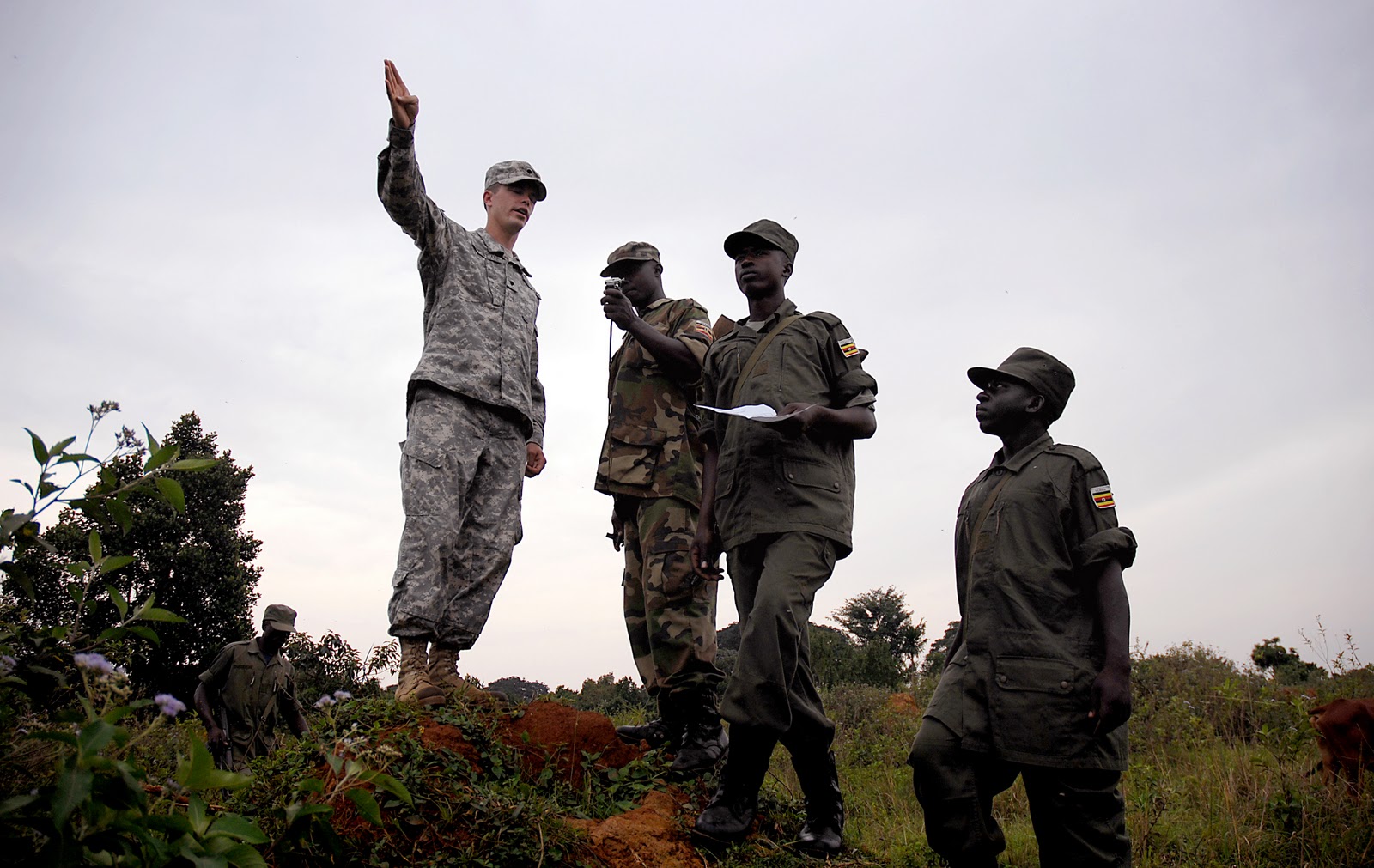
DRC: Civilians suffer as Uganda takes on LRA, IRIN, 01.20.2009U.S. Troops Train Ugandan Soldiers, Photo Essay, U.S. Department of Defense, Black Star News, 02.12.2008
Peace in Northern Uganda via U.S. Bullets and Bombs, Black Star News, 03.29.2010
How Invisible Children Falsely Marketed The LRA Disarmament and Northern Uganda Recovery Act, Black Star News, 06.02.2010Congo Genocide; Obama Knows the Real Story, Black Star News, 10.07.2010
Sen. Barbara Boxer Co-sponsored Bill That Strengthens African Genocidal, Homophobic, Dictator, Black Star News, 09.22.2010
Friday, December 3, 2010
General Kagame in Bruxelles
See Basta Impunity in Rwanda, with language selections; http://www.bastadeimpunidadenruanda.org/.
GENERAL KAGAME A BRUXELLES from CONGOTV on Vimeo.
Labels:
Congo,
Congo War,
Paul Kagame,
Rwanda,
Rwanda Genocide
Subscribe to:
Posts (Atom)