Showing posts with label Pentagon. Show all posts

Sunday, January 2, 2011

Pentagon burns bio-fuels to secure fossil fuels; more of both come from Africa


The Boeing F/A-18F Super Hornet flew over Naval Air Station Patuxent River, Md. on Earth Day, April 22, 2010, powered by a blend of 50 percent biofuel and 50 percent kerosene-based jet propulsion fuel.  The FA-18F  is a new generation of the  FA-18s, which include the FA-18Es that fly over San Francisco each October, on Columbus Day, during the Blue Angels Air Show.   In 2010, San Francisco's Fleet Week and Blue Angels Air Show, which comes to the City every October at the City of San Francisco's invitation, showcased Boeing's new AH-64D biofuel-powered attack helicopter


Walnut Creek, California based Eco-Fuel Global is a world leader in the new biofuels industry. Opponents of its biofuels planting projects, in Africa and other parts of the Global South, argue that cropland should be used to grow food, to feed people, not to grow more combustible fuel, and that its jatropha biofuel crop is highly toxic.


On New Year's Eve, KPFA Radio News aired this report on the Pentagon's consumption of both fossil fuels and biofuels, and Africa as a source of both: 
KPFA Radio News, 10.31.2010:


KPFA News Anchor Anthony Fest:
The US military uses far more fuel than any branch of the American government, and the US Air Force uses far more fuel than its other branches. On December 20th, Defense Industry Daily, a trade publication reporting military purchasing news for defense procurement managers and contractors, reported that the Defense Logistics Agency had issued over 1.5 billion dollars worth of fuel contracts this month. Africa peace and social justice activists say that more and more of the fuel consumed by the U.S. military, and by other U.S. consumers, comes from Africa. KPFA's Ann Garrison has the story.

KPFA/Ann Garrison:
The Defense Logistics Agency typically issues large sets of fuel contracts over concentrated periods during the year, but continues to issue fuel contracts all year long. Defense fuel purchases are typically frenzied during the month of March. In March 2009, DLA fuel contracts totaled $5.5 billion. This month, as of December 20th, the agency had issued over $1.5 billion fuel contracts.

Africa activists have pointed out that more and more of the fuel consumed by the U.S. military and other American consumers comes from Africa, and that Africa has surpassed the Middle East as a source of U.S. oil imports. Liberian/American Emira Woods, of the Institute for Policy Studies, says that this is confirmed by Department of Energy statistics:


Emira Woods, Liberian American scholar, activist, and 
editor of Foreign Policy in Focus at the Institute 
for Policy Studies in Washington D.C.
Emira Woods, Institute for Policy Studies:
That's from the Department of Energy tables. They come out at the end of each year. So they're about to come out now for 2010. At the end of December they'll come out for 2010. It's basically looking at those Department of Energy oil imports. So for Africa, it's about 24%. From the Middle East, it's varied over the years, from 21 to 19, since 2008.

KPFA:
Organizations like the US Army Corps of Engineers, and the Brookings Institute have raised concerns about meeting the U.S. military's huge demand for fuel in the future, and both coal-to-liquid transportation fuel, and biofuels have been proposed as substitutes. The U.S. military is already the largest consumer of Coal to Liquid transportation fuel, mostly purchased from the South African SASOL corporation. And in March, 2009, Aviation Week announced, that U.S. Air Force officials would acquire more than 300,000 gallons of biofuels for use in a 50-50 mix with kerosene-based jet fuel by 2013.

In "Biofuels and Neocolonialism," a group of six scholars writing for the Pambazuka News said that biofuels had caused, quote, "a new and massive land-grabbing scramble in Africa, unprecedented since the fall of colonialism, claimed to be justified by fears of global climate change."

The San Francisco Green Party's Eric Brooks has long spoken out against such claims:


Eric Brooks, of Our City, a San Francisco community
activist organization, and the San Francisco Green Party. 
Eric Brooks, San Francisco Green Party:
We all know that the main reason the U.S. military exists in its massive state right now is to go around the world and grab places that have fossil fuel and guard that fossil fuel, so that we can get it and use it and corporations can sell it. And, it's just really twisted logic to burn crop-based bio-fuels to go grab fossil fuels like oil.

KPFA:
Mozambique, Burkina Faso, and many other African countries have rejected biofuels, and an American biofuels corporation, EcoFuel Global, has stirred anger with its biofuels project in Rwanda, where land is scarce, population is dense, and people are hungry.

For Pacifica-KPFA Radio, I'm Ann Garrison.
Thursday, April 29, 2010

Cobalt and the Pentagon in Central Africa


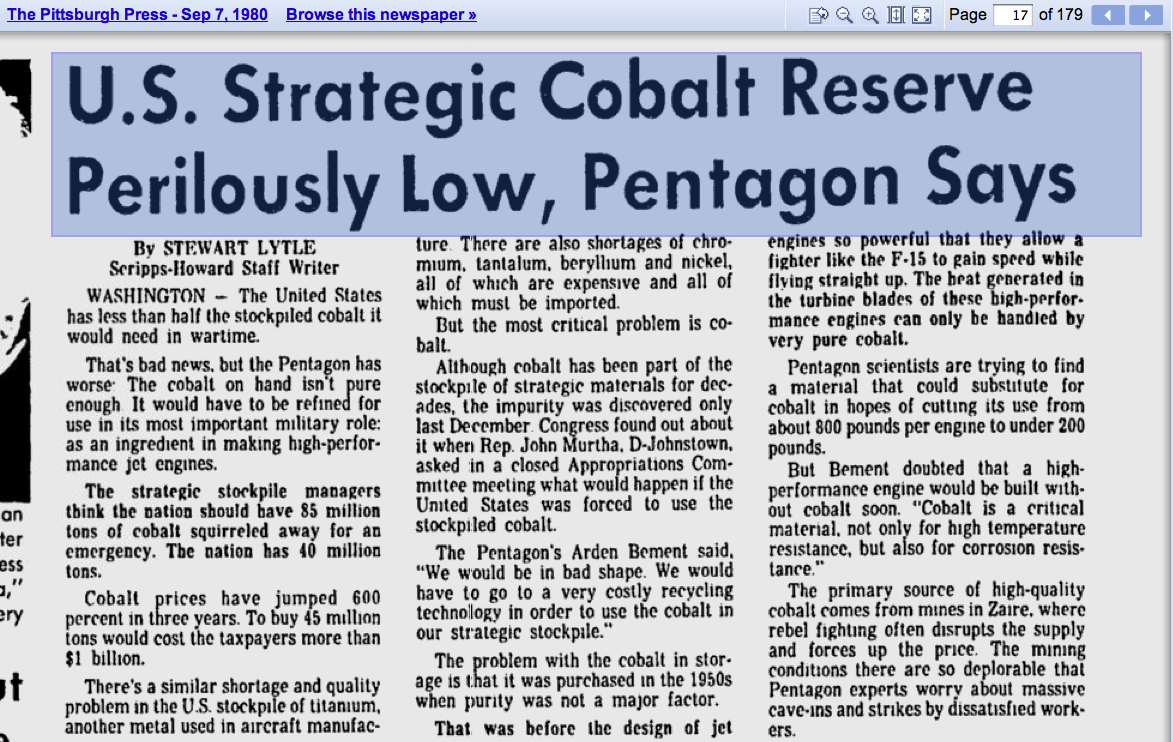
This 09.07.1980 report is central to the story of Pentagon intervention and covert war in Central Africa. Much of the world's cobalt reserves are in the Katanga Copper Belt running from Southeastern D.R. Congo into Zambia.
Cobalt in 1998, http://goo.gl/tGu2
US Strategic Cobalt Reserve Perilously Low, Pentagon Says, 1980, http://goo.gl/C6SR
Cobalt: Policy Options for a Strategic Mineral, 1982, http://goo.gl/5Hg0

Tuesday, March 23, 2010

UK and US finance Central African War; eight million Africans die

KPFA Radio News broadcast, 03.23.2010:


As a law professor, criminal lawyer, and Lead Defense Counsel for the International Criminal Tribunal on Rwanda, Professor Erlinder is very careful to be sure he has evidence supporting any statement he stands by, and he says the evidence is all here, in his Rwanda Documents Project which I'm just getting started on, http://www.rwandadocumentsproject.net/gsdl/cgi-bin/library


He knows he's on the Rwanda Hit List that Keith Snow reported last week, http://www.consciousbeingalliance.com/2010/03/the-rwanda-hit-list/, but said he's expendable because the documents are all there.


He also said that if there had been any reporters with audience at the ICTR in 2009 when the court ruled that there was no conspiracy to commit genocide in Rwanda in 1994, the received history of the genocide---including Kinzer's---and the RPF/Kagame regime's justification would have crumbled.


I told him that Kagame had compared the Rwanda Genocide to 09/11 when talking to Christiane Amanpour on CNN last week, and he said, "That would be ironic indeed, wouldn't it? If 09/11 really were a false flag," meaning a false history to rally around, like the received history of the Rwanda Genocide. 


But, he didn't want to comment on 09/11 beyond that, having no proof at hand.

Thursday, March 11, 2010

Just what Haiti doesn't need: Rwandan Police

In case anyone needed further evidence that President Paul Kagame's Rwanda is the Pentagon's proxy, 140 Rwandan Police are about to undertake special training before heading to Haiti, as reported in the Rwanda New Times, because, according to Rwandan Police Chief Edmund Kayiranga, "Rwanda wants to be involved in promoting peace in other countries and if need be, they would send more peacekeepers to other countries."
Rwandan Police are off to Haiti to promote peace, even as: 
1) Grenades explode in Kigali in the run up to its 2010 presidential election, and two of three viable parties are still unable to register and field candidates against incumbent President Paul Kagame.
2)  A new list of the five most horrible prisons on earth includes Rwanda's Kigali Gitarama Prison, and describes it as the most overcrowded penitentiary in the world, so overcrowded that prisoners have no choice but to stand up all day while their feet rot in filth, often developing gangrene, which may require amputation.  (Amnesty International reported, in 2007, that Gitarama Prison was way overcrowded, with 7,477 prisoners in space for 3,000.)  
3)  Top military commanders and government officials flee the country, and journalists go into hiding to escape arrest
4)  Amnesty International, Human Rights Watch, Reporters without Borders, the Committee to Protect Journalists, the Commonwealth Human Rights Initiative Group, the Africa Faith and Justice Network, the Greens European Free Alliance, and Senator Russ Feingold, D-WI, Chair of the U.S. Senate Subcommittee on Africa, call for human rights, an end to attacks on political opposition, and a free and fair presidential election, with polls scheduled for August 9th, 2010.
And why does Haiti need all these U.S. and UN Troops and now, Rwandan Police "peacekeepers"?    
Even France accused the U.S. of occupying rather than aiding the former jewel of the French empire, but it's very difficult to interpret this as anything but France's pseudo moral complaint against its longstanding imperial competitor--England and the Anglophone world---in Africa, Asia, and the Caribbean.  


Before the catastrophic Haitian earthquake on January 12th, 2010, Haitian lawyer and human rights activist Margeurite Laurent pointed to little known oil reserves and mineral riches to explain the already existing UN and U.S. occupation of her homeland, on Salon.com, CKUT Radio, and the San Francisco Bay View. 


Sound familiar?  Where else do Rwandan troops, if not police, serve?  Wherever the U.S. wants to project military force in Africa, including resource rich nations, like oil rich Sudan, which the U.S. forever threatens to invade "to stop genocide," and now, resource rich Haiti, which much of the world perceives as a part of Africa as much as a part of the Americas. 

And, oil and mineral rich D.R. Congo, where the Rwandan Army's constant invasions and mineral theft in that country's tortured eastern provinces were finally, in January 2009, officially sanctioned, with the announcement that the Rwandan Defense Force would collaborate with the Congolese Army (FARDC), the Rwandan CNDP militia, and UN Peacekeepers (MONUC), to, so they said, go after the FDLR, the Rwandan Hutu refugee militia.  The FDLR is the eternal excuse for military aggression and mineral theft in eastern Congo.  


The Congolese FARDC and MONUC had been engaged in a fierce fight with the National Congress for the Defense of the People (CNDP), backed, in stealth, by the Rwandan Defense Force up until January 20, 2009, when they suddenly joined forces, with the applause of the U.S. State Department, and the assistance of AFRICOM, the U.S. Africa Command.   Human Rights Watch (HRW), in May 2009, predicted that the consequence would be another human catastrophe in eastern Congo and by December 2009, HRW and major news outlets in the region reported that it had.   


This unlikely and unholy alliance emerged in eastern D.R. Congo, on Barack Obama's Inauguration Day, when all eyes were on Washington D.C., the first African American U.S. president, Reverend Rick Warren, celebrities all over the streets, and Aretha Franklin's hat.    So little of the world heeds or makes sense of Sub Saharan African news that only a handful of bloggers, dissident journalists and scholars noted, that D.R. Congo had, that day, become a violent D.R. Disneyland.


In December 2009, Keith Harmon Snow reported, in Dissident Voice and the San Francisco Bay View, that soldiers of the Rwandan Defense Forces were being flown all the way across D.R. Congo, from its eastern border with Rwanda to its Western border with the Republic of Congo, in oil and timber rich Equateur Province, to join AFRICOM, UN Peacekeepers (MONUC), and Belgian paratroopers, in suppressing the Dongo Rebellion.  


Why not Congolese soldiers?   Because they lack the discipline of the Pentagon's Rwandan proxy army, and, as Keith Snow reported, many of them were defecting to join the Western Congolese fighters calling themselves the Resistance Patriots of Dongo.


Now, with 140 Rwandan Police about to undertake training to serve as peacekeepers in Haiti, the first question is:  Why peacekeepers?  Didn't Haiti suffer an earthquake, not a war, aside from the arrival of 10,000 U.S. troops?  


And, why not 140 more Haitian Police?  Why Rwandans? If Haiti needs "peacekeepers" within its own borders, shouldn't Haitians be best able to keep the peace?


Yes, but not the peace that those now managing the U.S. occupation of Haiti want


In February 2007, the New Times reported that the FBI was training Rwandan Police in modern interviewing and interrogating techniques, and, in counter-terrorism, criminal investigation, and cyber crimes investigation. 

Thursday, February 18, 2010

Link TV quotes Nicholas Kristof, calling for an earthquake in Congo

Eastern Congolese women are not only raped and tortured in the violent scramble for the region's vast natural resources; their suffering is then manipulated to raise funds for the non-profit industrial complex, and to justify ongoing U.S. military engagement.

Sometimes I despair of ever seeing the truth come out about the imperial scamble for resources in D.R. Congo and the rest of Africa.  Now even Link TV, generally considered to be a "progressive" outlet,  is quoting the NY Times's Nicholas Kristof on how much he'd like to see an earthquake, like Haiti's, or a tsunami in Eastern Congo turn attention to the "barbaric civil war" in Eastern Congo:

"Sometimes I wish eastern Congo could suffer an earthquake or a tsunami, so that it might finally get the attention it needs. The barbaric civil war being waged here is the most lethal conflict since World War II and has claimed at least 30 times as many lives as the Haiti earthquake." - Nicholas Kristof, New York Times, http://www.nytimes.com/2010/01/31/opinion/31kristof.html
 
These barbaric African people, according to Kristof's reasoning,  just can't stop killing each other, so we Western white folks just have to give them some more of our "attention."   


Since Kristof and the Pentagon are still waiting for their earthquake, violence against women in this "barbaric civil war" will have to do.

Stop Violence Against Women in Congo

Very hard to argue against this campaign, this "Run for Congo Women," no?   I'm against violence against women, in Congo and everywhere else.

But I also think Nicholas Kristof should be sold into slavery, or, at the very least fired, for promoting such a racist, imperial, ahistorical distortion of the Congo war and the pain of the Congolese people.

Any Western narrative about Congo should begin by looking back to the assassination of Patrice Lumumba, in 1961, ordered by Dwight Eisenhower, which truncated the hopes and possibilities of the Congolese people, despite their hardwon, and still nominal, independence, in 1960.